The Silicon Shock and What India Can Build From Its Own Waste
- Aarav Shah
- Jun 15
- 3 min read


Captive Power & Materials Sovereignty in the AI Build-Out
Technology has stopped behaving like a deflationary tailwind and started behaving like energy — a strategic input, a price shock, and a balance-of-payments drain. The question for India is no longer how to price technology, but how much of it can be supplied domestically, and from what resources. Key Takeaways
Be honest about the layer. The current price spike is primarily a memory and compute story. We do not claim to solve that challenge.
Win the adjacent layer. Power and power-electronics materials are where India can realistically build competitive advantage.
Pinakin HPFC is the near-term opportunity. Captive hydrogen-based power that is commercially viable today, with fast payback periods.
BharatSiC is the long-term sovereignty play. Silicon carbide produced from domestic waste streams instead of imported feedstock.
The Technology Cost Shock
Recent global analysis suggests that technology, once a source of falling costs, is now behaving like a strategic commodity similar to energy.
Global IT spending is projected to reach approximately $6.3 trillion by 2026, with AI-related spending approaching $2.5 trillion. This level of investment is comparable to global clean-energy spending and several times larger than annual oil-supply investments.
The impact is visible through:
Memory shortages
Rising AI operating costs
Growing dependence on imported compute infrastructure
Widening current-account deficits for technology-importing nations
Where the Exposure Exists — And Where It Doesn't
The core of the current technology shock lies in:
DRAM
High-bandwidth memory (HBM)
NAND
Advanced logic chips
The recurring cost of AI computation
India cannot realistically close this gap in the near term, and Y-Capita does not claim to.
Instead, the opportunity lies one layer below:
Power generation
Power infrastructure
Power-electronics materials
These markets are large, rapidly growing, import-dependent, and most importantly, can be built using Indian resources.
Strategic Positioning
Layer | Exposure | Y-Capita Position |
Memory & Logic | Core price shock | No direct position |
AI Compute & Power | Rising infrastructure costs | Pinakin HPFC |
Power-Electronics Materials | Strategic future bottleneck | BharatSiC (proposed) |
Key Insight: Conceding the memory layer strengthens the credibility of the power and materials strategy.
The Near-Term Solution: Pinakin HPFC
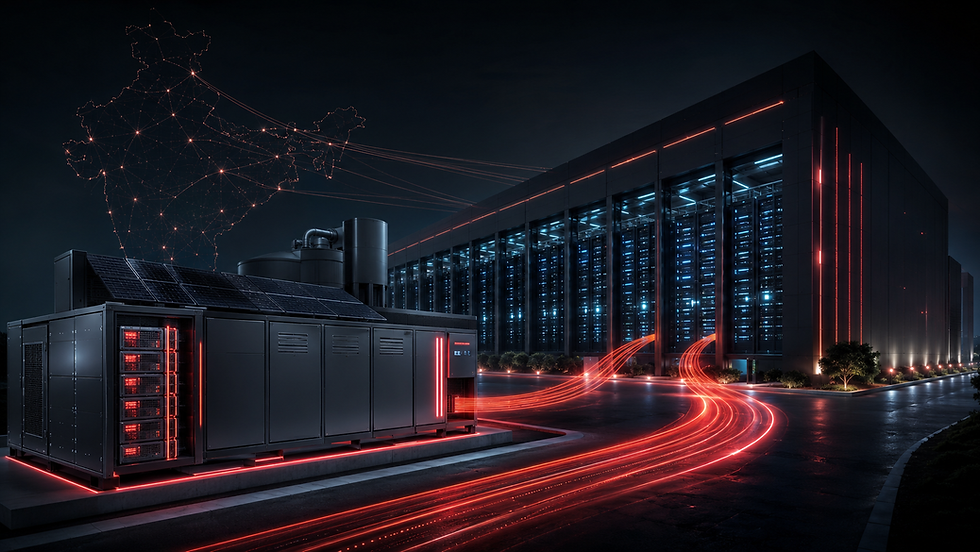
AI infrastructure ultimately depends on power.
As data centers expand and AI workloads increase, electricity demand is growing faster than many national forecasts anticipated.
Pinakin HPFC addresses this challenge through:
Modular hydrogen fuel-cell systems
Deployment sizes from 33 kW to 1 MW
On-site power generation
Fuel-cost-driven economics rather than utility-driven pricing
Commercial deployment readiness today
Economics Snapshot
For a 1 MW IT load operating at a PUE of 1.5:
Estimated LCOE: approximately ₹5/kWh
Typical grid power comparison: ₹6–9/kWh
Estimated payback: around 1.7 years versus grid power
Faster payback compared to diesel alternatives
The commercial value proposition is immediate, measurable, and deployable.
The Sovereignty Flagship: BharatSiC (Proposed)
As industries increasingly adopt silicon carbide (SiC) for:
Data center power systems
EV powertrains
Solar inverters
Grid infrastructure
SiC is becoming a strategic material.
Today, much of the supply chain remains import-dependent.
BharatSiC's Proposition
Recover high-grade silica from:
Steel blast furnace slag
Alumina red mud
Other domestic industrial waste stream
Instead of importing feedstock, India can refine and utilize its own waste resources.
In simple terms:
Conventional silicon is like a standard pipe.
Silicon carbide is a high-pressure industrial pipeline capable of handling greater heat, higher power densities, and lower energy losses.
This makes it increasingly critical for modern energy infrastructure.
Important Note: BharatSiC remains a proposed strategic initiative and should be positioned as a long-term sovereignty opportunity rather than a near-term commercial offering.
The Strategic Framing
The current technology shock is fundamentally a supply constraint.
The mistake is chasing the constrained commodity itself — memory.
The smarter position is owning the adjacent inputs that everyone will need more of:
Power generation
Power-electronics materials
Both can be produced domestically.
One of them can potentially be produced from India's own waste streams This is not a bet on chips. It is a bet on the infrastructure required to support them.
Audience & Next Steps
Policy & Sovereignty Stakeholders
MeitY
India Semiconductor Mission
MNRE
NITI Aayog
Commercial Buyers
Hyperscale data centers
Colocation operators
Large AI infrastructure developers
Strategic Capital
Sovereign-focused investors
Infrastructure investors
Long-term industrial capital
Recommended Sequencing
Lead with Pinakin HPFC as the commercially proven solution.
Use BharatSiC as the long-term sovereignty narrative.
Engage government stakeholders through the materials-independence and semiconductor-resilience story.
Conclusion
The winning strategy is not to compete directly in memory and advanced chip manufacturing.
The opportunity lies in building ownership of the infrastructure that AI and advanced computing inevitably require: power generation and power-electronics materials.
Pinakin HPFC provides the near-term commercial wedge.
BharatSiC provides the long-term sovereignty vision.
Comments