Entity 2 Expands Into Next-Generation Solar
- Aarav Shah
- Jul 6
- 3 min read

Building India’s Next Clean-Energy Breakthrough With Indigenous Solar Materials
Entity 2 Energy Storage Pvt. Ltd., an operating entity of Y-Capita Group, is expanding its clean-energy portfolio beyond advanced battery cells into next-generation solar technology.
Alongside its solid-state battery and energy-storage programmes, solar cells are now becoming a core focus area for Entity 2. The company is working on an indigenous solar absorber material designed around India’s real manufacturing gap: the need to move beyond solar assembly and build deeper control over the solar cell supply chain.
A New Solar Material Built From Earth-Abundant Elements
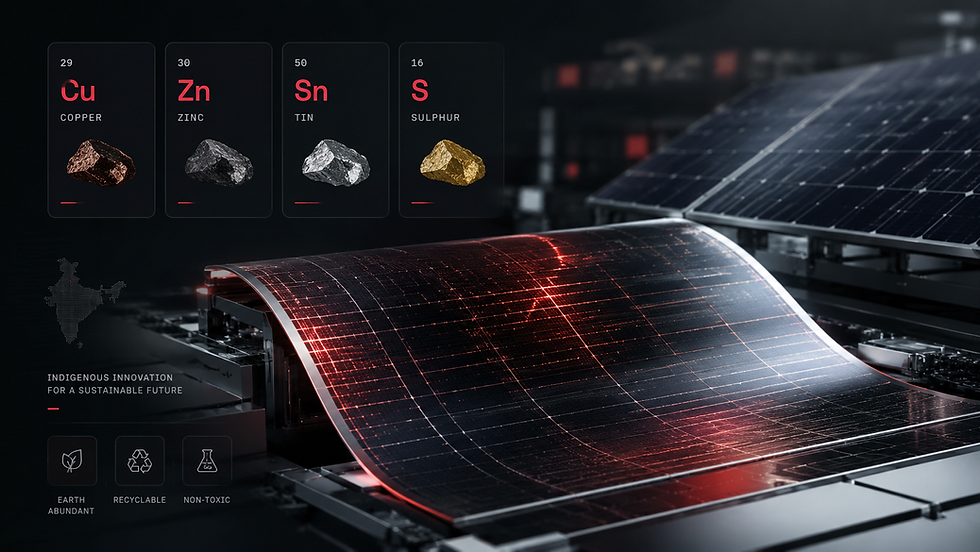
Over the first half of 2026, Entity 2 has made significant progress on a solar absorber based on kesterite Cu₂ZnSnS₄, also known as CZTS.
This thin-film material is made using four earth-abundant elements:
Copper | Zinc | Tin | Sulphur
Unlike conventional silicon-based solar cells, this material does not depend on polysilicon or silicon wafers. This gives Entity 2 a strong pathway toward developing a solar cell material that can be sourced, processed, and scaled with a more indigenous supply chain.
Addressing India’s Solar Manufacturing Gap
India has made major progress in solar module assembly, but the upstream materials required to make solar cells are still heavily dependent on imports. In many cases, even cells manufactured in India continue to rely on imported silicon wafers and imported polysilicon supply chains.
Entity 2’s CZTS absorber is being developed to move around this dependency.
By using copper, zinc, tin, and sulphur, the material creates a new route for solar cell development that does not require imported silicon wafers. This makes the technology highly relevant for India’s long-term clean-energy independence.
Independent Characterisation Confirms Progress
The CZTS material developed by Entity 2 has undergone independent characterisation by a leading Indian photovoltaics research laboratory.
The results confirmed the formation of the target kesterite phase, identified the optimal processing temperature, and created a clear roadmap for improving the material from its current research-stage form toward device-grade phase purity.
This marks an important step in moving the technology closer to solar cell integration.
Designed For A More Sustainable Solar Future
Next-generation solar technologies are no longer judged only by efficiency. The future of solar also depends on what the material is made from, how safe it is, and what happens to it at the end of its life.
Entity 2’s CZTS absorber offers a strong sustainability advantage because it is built from abundant, non-toxic base metals. Copper, zinc, and tin already have mature global recycling and recovery systems, making the material better suited for safer end-of-life handling and recovery.
The absorber is also lead-free, which gives it an important advantage over lead-based perovskite chemistries, where end-of-life lead management remains a key commercialisation challenge.
Roadmap Toward An Indigenous Solar Cell
Entity 2 is now advancing the absorber toward device integration, with a proof-of-concept solar cell targeted for FY 2026–27.
The goal is to build this proof-of-concept cell on a fully indigenous material supply chain as phase purity and cell fabrication are further developed.
This work complements Entity 2’s battery-cell roadmap and strengthens the company’s commitment to India’s clean-energy self-reliance.
Statement From Entity 2
A solar material should be judged not only by how much power it converts, but also by what it is made of and what becomes of it at the end of its life. Our material is built from abundant, non-toxic elements, Indian at the source and recoverable at the finish. This is the kind of solar cell India needs to own, not just assemble.
About Entity 2 Energy Storage Pvt. Ltd.
Entity 2 develops advanced energy-storage and clean-energy technologies, including its solid-state battery programme and next-generation photovoltaic materials.


Comments